
BlackOut Series Hydro-Boost Brake Kits
Upgrade your classic with BlackOut hydro boost kits that provide power brake assistance through the power-steering hydraulic system instead of engine vacuum. Explore vehicle-specific systems with black POL and Wilwood master cylinder options for popular classic cars and trucks.
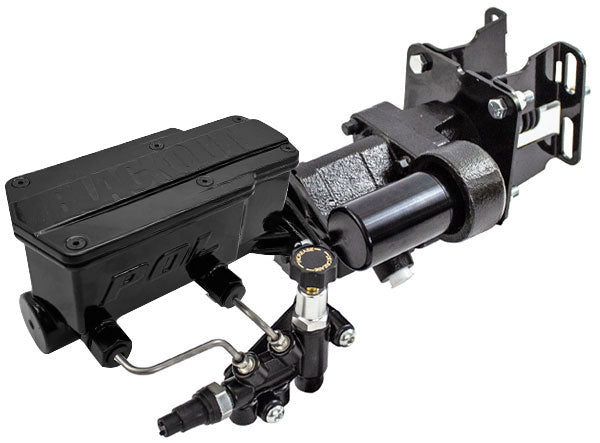
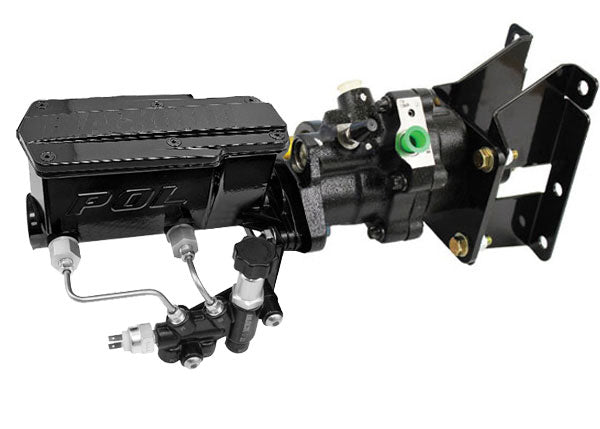


BlackOut Hydro Boost Brake Systems
BlackOut hydro boost systems shift brake assist from engine vacuum to the power-steering circuit. Hydraulic pressure from the steering pump provides the assist, making these systems well-suited to builds where engine modifications leave little consistent vacuum.
That means the brake system now shares part of its operation with the steering system. Pump capacity, hose routing, steering gear or rack connections, and return plumbing become part of the installation, along with the master cylinder and pedal connection.
Vehicle-specific systems cover multiple generations of Chevy and GMC trucks, plus Chevelle, Camaro, Bel Air, Impala, Nova, Pontiac GTO, and 1953-56 Ford F-100 applications. POL and Wilwood master cylinder configurations add further variation between those setups.
The black finish ties the collection together visually, but the defining feature is hydraulic assist: braking power supplied through the steering circuit rather than through manifold vacuum.
FAQ
How do I choose the right BlackOut hydro boost kit for my vehicle?
Start with the vehicle year, make, and model, then confirm the firewall mounting, pedal connection, brake configuration, master cylinder requirements, and power-steering system. The 14 products in this collection are primarily vehicle-specific, covering applications such as Chevy/GMC trucks, Camaro, Chevelle, Nova, Impala, Bel Air, Pontiac GTO, and Ford F-100.
What is the difference between hydro boost and a vacuum brake booster?
A conventional power brake booster relies on engine vacuum to provide braking assistance. Hydro boost uses hydraulic pressure from the power-steering system instead. This makes hydraulic assistance particularly useful for some performance engines that do not consistently produce enough vacuum for a traditional booster.
Does my vehicle need power steering for a BlackOut hydro boost kit?
Yes, a hydro boost system requires a compatible hydraulic power-steering system because that system supplies the pressure used for brake assistance. The power-steering pump, steering gear or rack, hydro boost unit, hoses, fittings, and return routing need to work together as a complete hydraulic system.
Can I choose between POL and Wilwood master cylinders?
Many products in this collection offer POL or Wilwood master cylinder configurations, although the available choices depend on the specific application. Some products use a particular Wilwood or Wilwood-style master cylinder setup. Check the individual product options before ordering rather than assuming both choices are available for every vehicle.
When should I choose hydro boost instead of a BlackOut vacuum booster?
Hydro boost is worth considering when the engine produces limited or inconsistent vacuum or when the vehicle is better suited to hydraulic brake assistance. Modified engines with aggressive camshafts are a common example. The choice should also account for available space, the power-steering system, brake configuration, and how the vehicle is being built.
Are BlackOut hydro boost kits available for both classic cars and trucks?
Yes. The collection includes truck applications for several generations of Chevy/GMC pickups and a 1953-56 Ford F-100 firewall-mounted system. Classic car applications include Chevelle, Camaro, Bel Air, Impala, Nova, and Pontiac GTO. Always select according to the exact year and application listed for the individual product.
What should I check before installing a BlackOut hydro boost system?
Confirm the firewall mounting pattern, pedal connection, master cylinder compatibility, brake configuration, power-steering pump, steering gear or rack, hydraulic hose routing, fittings, and available engine-bay clearance. You should also check exactly what the selected kit includes and determine whether additional hoses, fittings, proportioning components, or other installation parts are required.