
AirRide
Build an air ride suspension around your classic car or truck with vehicle-specific front and rear kits, CoolRide systems, ShockWave components, compressors, tanks, controls, and supporting hardware for popular Chevy, GMC, Ford, Pontiac, and other applications.



Air Ride Suspension and Air Management Systems
Air ride is really two systems working together: the suspension that carries the vehicle and the air management that changes its pressure. One side determines how the car or truck sits and moves; the other determines how air gets there and how the driver controls it.
On the suspension side, the collection includes air springs, CoolRide kits, ShockWave systems, brackets, shocks, and vehicle-specific mounting hardware for C10 and C20 trucks, Impala, Bel Air, GM A-Body and G-Body cars, Camaro, Firebird, Nova, Mustang, and other classics.
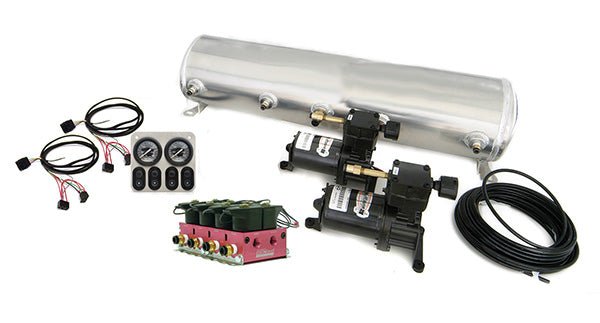
The management side has a completely different job. Compressors create the air supply, tanks store it, 2-way and 4-way systems distribute it, and RidePro controls, height sensors, AirPod systems, and key-fob controls manage the pressure.
This split lets a build take different paths: a vehicle may need only front or rear suspension hardware, a complete suspension setup at both ends, or the air-management components required to operate equipment already installed.
FAQ
What is included in an air ride suspension kit?
Contents vary by product and vehicle. For example, POL's 1963-72 Chevy/GMC C10/C20 rear system includes air springs, shock absorbers, mounting brackets, and hardware. Other products may contain different components, so always check the individual kit rather than assuming every air ride package includes the same parts.
How do I choose the right air ride suspension kit for my vehicle?
Start with the exact year, make, and model. Next, determine whether you need a front kit, rear kit, or both, and identify the suspension currently installed. Then consider the compressor, tank, controls, and other air-management components needed to operate the suspension.
Are separate front and rear air ride kits available?
Yes. Many applications have separate front and rear systems. For example, the collection contains individual front and rear kits for 1978-88 GM G-Body cars, while 1958-64 Impala, Belair, and Biscayne applications have separate RideTech CoolRide front and rear systems.
What is the difference between CoolRide and ShockWave air suspension?
They are different RideTech suspension product designs. The collection includes CoolRide kits for applications such as 1955-57 Chevy Belair and 1958-64 full-size Chevy cars, while ShockWave products are available for Camaro, Firebird, Nova, Chevelle, Mustang, Impala, and G-Body applications. Compare the individual product design and fitment rather than treating the two names as interchangeable.
Do I need a compressor system for air ride suspension?
An onboard air-management setup allows air pressure to be supplied and controlled from the vehicle. POL carries several RideTech compressor systems, including 2-way and 4-way analog systems, RidePro configurations with different tank capacities, and an AirPod RidePro-X system. The appropriate setup depends on how the suspension will be controlled.
What size air tank is available for these air ride systems?
The current collection includes compressor and AirPod systems using 3-gallon and 5-gallon configurations. Tank size is only one part of the decision, so compare the complete compressor and control system with the requirements of the air suspension being installed.
What should I check before installing air ride on a modified classic car or truck?
Confirm the suspension and chassis configuration currently installed, including any previous lowering, control-arm, axle, frame, or wheel and tire changes. Then verify the air suspension's vehicle fitment, mounting requirements, available clearance, and the air-management equipment needed to operate it.