
4 Link Suspension Kits
Replace the traditional rear suspension layout with vehicle-specific 4-link systems for classic cars and trucks. Find triangulated, adjustable, heavy-duty, mini-tub, stock-width, and narrowed rear-end configurations for Chevy, GMC, Ford, Pontiac, and other popular applications.
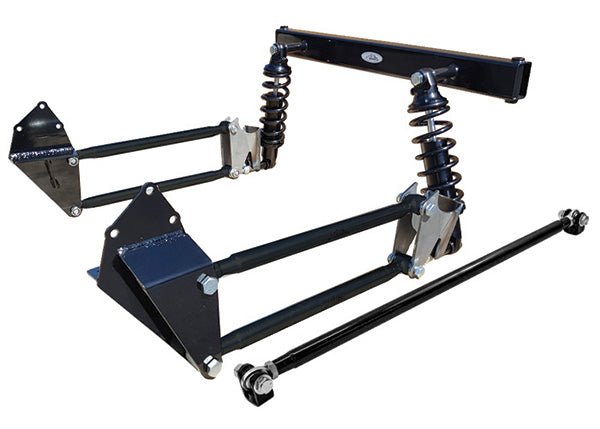


4-Link Suspension for Different Rear-End Builds
A 4-link changes what you can build the rear suspension around. Instead of treating axle location, ride height, and tire clearance as fixed factory limitations, different link layouts and mounting points let you configure the rear of the vehicle around the direction of the build.
That becomes especially noticeable once wider tires come into play. Mini-tub systems for Mustang, Camaro, Firebird, and Nova applications are designed around rear packaging that differs significantly from a stock-width setup, with some Camaro and Firebird kits also separated by stock or narrowed axle housings.
Truck systems solve a different packaging problem. Chevy/GMC, C10, Ford F-100, and Heidts applications span several chassis generations, including standard and heavy-duty configurations where frame layout and rear axle position shape the suspension design.
Adjustment adds the final variable. Standard adjustable links, double-adjustable systems, and Johnny Joint upgrades allow different levels of control over axle position and suspension geometry, making the 4-link itself part of how the rear chassis is configured rather than simply a replacement for the original suspension.
FAQ
How do I choose the right 4-link suspension kit for my car or truck?
Start with the exact year, make, and model, then identify the rear axle housing and current rear suspension. Check whether the vehicle has a stock-width or narrowed rear end, mini tubs, wider tires, or other chassis modifications. Finally, compare the individual kit's mounting requirements, adjustability, and included components.
What vehicles have 4-link suspension kits available in this collection?
POL currently lists systems for numerous classic applications, including Chevy and GMC trucks, Ford F-100, Chevy Belair, Chevelle, Camaro, Firebird, Nova, Ford Mustang, Falcon, and Fairlane. Exact year ranges vary substantially between products, so vehicle-specific fitment should always be checked.
What is a triangulated 4-link suspension?
A triangulated 4-link uses angled links as part of the rear axle locating arrangement. This differs from other 4-link layouts that may use additional lateral axle-location components. POL currently lists triangulated configurations for applications including the 1955-57 Chevy Belair. The exact design and required components should be confirmed on the individual kit.
Are 4-link kits available for mini-tub cars?
Yes. The collection contains mini-tub-oriented systems for applications including 1964-70 Mustang and 1970-81 Camaro/Firebird. There are also first-generation Camaro/Firebird configurations for narrowed rear ends and Nova products intended for wide-tire builds. Match the kit to the actual axle width, tubs, wheels, and tires being used.
What is the difference between adjustable and double-adjustable 4-link kits?
Adjustability allows suspension-link dimensions or settings to be changed for the installation and setup. A double-adjustable configuration provides additional adjustment capability without treating every link arrangement as fixed. POL lists several double-adjustable 1967-69 Camaro and Firebird systems, including configurations for stock and narrowed rear ends.
Are 4-link suspension kits available for classic trucks?
Yes. Truck applications include 1947-53 and 1955-59 Chevy/GMC, 1953-56 Ford F-100, 1973-87 Chevy/GMC, a heavy-duty 1967-87 C10 configuration, and a Heidts 1965-72 Ford F-100 system. Because chassis and axle configurations vary, check the individual kit rather than assuming one truck 4-link fits multiple generations.
What should I check before ordering a 4-link kit for a modified vehicle?
Measure and identify the rear axle housing, wheel and tire dimensions, available chassis clearance, and current suspension mounting points. Determine whether the vehicle has mini tubs, a narrowed rear end, altered ride height, or other chassis modifications. Then compare those details with the exact kit because this collection contains stock-rear-end, narrowed-rear-end, wide-tire, mini-tub, and heavy-duty configurations.