
Steering-Stock Height Spindles
Keep the front suspension at its intended spindle height while choosing components that match the vehicle and brake setup. Explore stock-height disc brake, OEM-style, and replacement spindles for classic GM, Mopar, Chevy and GMC truck, and Mustang II applications.


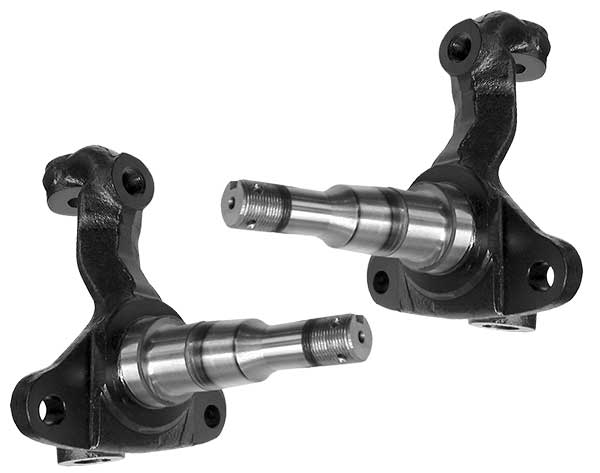
Stock-Height Spindles for Disc Brake and IFS Setups
Keeping the spindle at stock height removes lowering from the equation, but it does not make fitment simple. The real differences in this collection come from what surrounds the spindle: disc brake hardware, steering arms, hubs, bearings, control arms, and the suspension design itself.
GM passenger-car applications lean heavily toward OEM-style disc brake configurations. Camaro, Nova, GTO, and A-Body spindles let you change the front brakes while preserving the original ride-height relationship, with separate designs covering different chassis and year ranges.
Classic trucks follow another branch. C10 and C20 applications include Western Chassis disc brake spindles, replacement spindles, and heavy-duty stock-height configurations built around their respective front-end hardware rather than a shared truck design.
Mustang II systems sit apart from both groups. Standard-height Mustang II and Heidts spindles belong to an independent front suspension architecture in which the spindle supports the IFS layout without serving as the lowering component. Across the collection, “stock height” describes only where the wheel sits vertically; the suspension and brake package determine everything else.
FAQ
How do I choose the right stock height spindles for my vehicle?
Start with the exact year, make, and model, then identify the front suspension and brake configuration. Check the existing spindle, rotor or hub, bearings, caliper mounting, steering arms, ball joints, and control arms. Several products in this collection share similar descriptions but cover different applications, so match the spindle to the complete front-end setup.
What is the difference between stock height and drop spindles?
Stock-height spindles are intended to retain the standard spindle height rather than lower the vehicle through the spindle. Drop spindles reposition the wheel mounting point to produce a specified drop. If you want to maintain the current ride-height configuration while replacing the spindle or working with a compatible disc brake setup, this stock-height collection is the more relevant place to start.
Can I convert to disc brakes while keeping stock height spindles?
Yes, for compatible applications. Much of this collection consists of stock-height disc brake spindles for vehicles such as Camaro, Nova, Pontiac GTO, GM A-Body cars, Mopar A/B/E-Body vehicles, and Chevy/GMC trucks. Check the exact spindle because the rotor, bearings, calipers, brackets, and steering arms still need to match.
Are the GM stock height disc brake spindles OEM-style?
Several are specifically listed as OEM-type spindles. POL's FAQ also states that its 1964-72 stock spindle disc brake setup uses OE-type spindles with bolt-on steering arms. Individual product specifications should still be checked because the 16-product collection includes several different spindle designs and applications.
Are stock height spindles available for Chevy and GMC trucks?
Yes. The collection includes disc brake spindles for 1960-62 and 1963-70 Chevy/GMC C10 applications, replacement spindles for 1973-87 C10 trucks, and stock-height spindles for 1971-87 C20 trucks. Match the spindle to both the year and truck series before ordering.
Are stock height Mustang II spindles available?
Yes. Three of the 16 products are Mustang II-related stock or standard-height spindle choices, including a Mustang II stock-height spindle, Mustang II stock spindle set, and Heidts standard spindle configuration. Check the suspension system and associated brake components to determine which version matches the build.
What should I check before ordering stock height disc brake spindles?
Confirm the vehicle year and model, existing suspension, brake type, rotor and hub configuration, inner and outer bearings, calipers and brackets, steering arms, ball joints, control arms, wheels, and any previous front-end modifications. Maintaining stock spindle height does not automatically guarantee compatibility with the brakes or other suspension components.